



We are currently experiencing a fundamental shift of how UI/UX designers work. And like with most things today, it’s because of AI. Over the recent past, we’ve seen AI interface design tools enter the market — Google Stitch, Claude Design, Figma Make — in an attempt to bring AI’s productivity capabilities to the interface design world. These tools let you prototype from text prompts and design within minutes rather than hours, letting you unlock productivity at a higher scale.
But to be used and trusted by designers and clients alike, AI design tools need more than just instant UI generation. They need quality, context, trust, understanding, problem solving, critical thinking, evaluation — all human traits which AI simply does not possess yet. So let’s talk about how UI/UX design is changing under AI rule, and why UX designers are actually more important than ever.
AI to Enhance, Not Replace
Today, UI and UX design roles are often found in the one role, leaving designers filling two distinct responsibilities. This is often represented by the Double Diamond depiction of the design process, and is broken up into:
- Diamond 1: Research, empathise, narrow — this the crux of UX design where we are working to find the problems and what solutions might look like. You’re not building yet; we’re focused on exploring everything in our scope and narrowing to the problem we want to help.
- Diamond 2: Prototype, evaluate, refine — where you take all the background and knowledge and start to build interfaces, starting broad and then working to refine by testing and evaluating to arrive at a final design.
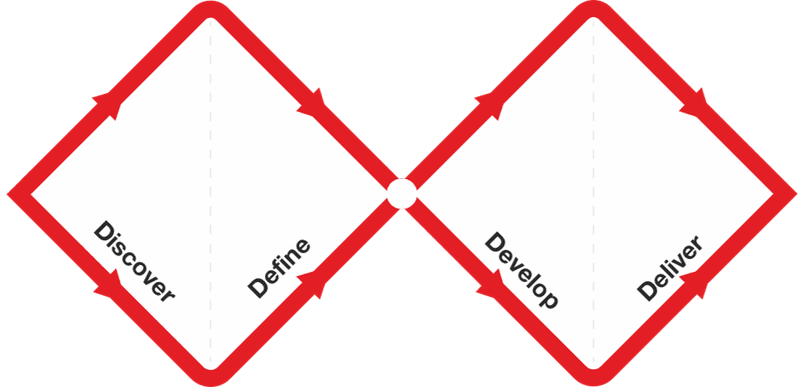
The key with AI is that we aren’t wiping the slate clean and replacing this with an swarm of AI agents. Doing so would lead to a complete collapse in the trust, effectiveness and value that UX design brings. Instead, we want to supercharge two distinct parts of the diamond.
1. More Complete Research (Discover Phase)
The crux of good UX design is being able to survey the scope and find problem spaces. That’s no different with AI, but tools like Perplexity can surface information quickly and comprehensively. The internet is arguably the most diverse place in the world, and AI tools have spent an enormous amount of time and compute on learning it all. What better tool to consult?
The key to good (and responsible) AI use for any type of research is simple: don’t trust the AI. Which might sound like there’s no point in using it in the first place. But in UX design, we can treat AI outputs as claims and work to verify them. This is crucial as we are designing for humans, not a hallucination-prone machine.
2. Prototyping Powerhouse (Develop Phase)
The second diamond is also about making, with the develop phase all about exploring prototypes. Before AI, prototyping ui ideas was a manual process, but not anymore — with AI, this phase gets a dramatic boost. AI a UI prototyping powerhouse that can bring you to the design iteration phase faster. With AI being able to churn out interfaces a lightning speed, the reality is that human-first interface design is dying out.
Today’s AI models can create quick, structured interfaces with multiple layout variants and design systems all while working in existing design stacks (like with Figma AI).
But with an oversupply of concepts, the human value instead shifts: your value comes from evaluation. Take the AI interfaces back to your team and start discussions. Question its choices. Laugh at where it went horribly wrong. Use AI to quickly make interactive UI prototypes to stoke discussion, evaluation and direction. Because at the end of the day, that’s the most important role for a UX designer.
Where UX Designers Retain Value

You may have noticed that both above applications of AI fall within the first phase of either diamond — and even then, does not replace the entire segment. AI has clear strengths, but humans do too. With AI in UX design, designers themselves must bring higher levels of critical thinking:
- You’re in charge of direction. AI might like to throw it’s two cents in, but the human ability to empathise, contextualise and decide are unmatched. AI can try and replicate what these might sound like, but it cannot duplicate what it means to have them.
- Human evaluation is critical to solving human problems. this becomes more true the more niche of a problem space. A context window cannot store the human experience, and even if it could, all the tokens in the world wouldn’t be enough to process what that actually means.
- Refinement and polish are still human traits. While AI can generate interfaces in seconds, it struggles with consistency and cannot ‘see’ the final result. It might be a great tool for prototyping, but the closer you get to a final deliverable, the less you want to rely on AI-assisted changes.
The Future
This leaves designers with a clear path forward: the future of UX design isn’t focused on how well you can create a Figma prototype or how quickly you can make changes to a UI design. Instead, AI in UX design has means the value we provide is less about making Figma prototypes and more about making sure the interactions we design are impactful. Best practices aren’t diving in head first and praying — it’s being deliberate in use for optimal outcomes.
We’re might not be primarily interface designers anymore. But we can instead focus on the critical parts of UX design — using our expertise to discuss, evaluate and empathise to reach better outcomes. Because after all, isn’t that why we do what we do?
UI & UX design in the AI era is tough to navigate. Using AI to replace the entire process might get results that look correct, but won’t work for real users. If you’re looking for UI/UX design that doesn’t fall for hallucinations, chat to FONSEKA today https://fonseka.com.au/contact