




Imagine standing at the top of a skeleton track at the Winter Olympics. You launch yourself headfirst down a narrow sheet of ice at more than 100 km/h. Now imagine the same track without barriers. No walls or containment. No margin for error.
Few athletes would willingly take that risk.
Yet many organisations are doing something remarkably similar with AI-assisted development.
Modern AI tools can write code, review pull requests, modify infrastructure, access repositories, generate documentation, and increasingly perform tasks that once belonged exclusively to developers. The productivity gains are remarkable. The risks are equally real.
Many discussions focus on the models themselves. Which model is best? Or which agent is fastest? Or which platform offers the greatest autonomy?
Yet a more important question is often overlooked as navigate this AI era:
As organisations embrace AI-assisted development, system design for AI is becoming a critical discipline. Not because AI changes the fundamentals of good engineering, but because it introduces a new challenge: building environments where intelligent systems can move quickly without creating unnecessary risk.
Historically, system design was largely concerned with building a scalable system focused on performance, reliability, and maintainability. Whether the architecture relies on monoliths, microservices or distributed cloud platforms, those fundamentals remain unchanged.
Building Effective AI Guardrails
The word “guardrail” can sometimes imply limitation. In reality, good guardrails exist to enable movement. A skeleton track is not safe because it prevents speed. It is safe because it allows competitors to travel at extraordinary speed while reducing the consequences of mistakes. The same principle applies to AI.
In fact, this is a primary function of senior engineers in a more traditional model.
Without appropriate controls and no established best practices, an AI agent may expose sensitive information, modify critical infrastructure, or trigger unintended downstream actions that create operational risk. As AI capabilities increase, so too does the importance of defining clear boundaries.
At the same time, overly restrictive systems create a different problem. Teams become constrained by controls that were designed for yesterday’s technology. New tools become difficult to adopt. Experimentation slows. Innovation suffers.
The objective is not maximum control.
Nor is it unrestricted freedom.
A Layered Approach to System Design for AI
One useful way to think about AI guardrails is through layers.
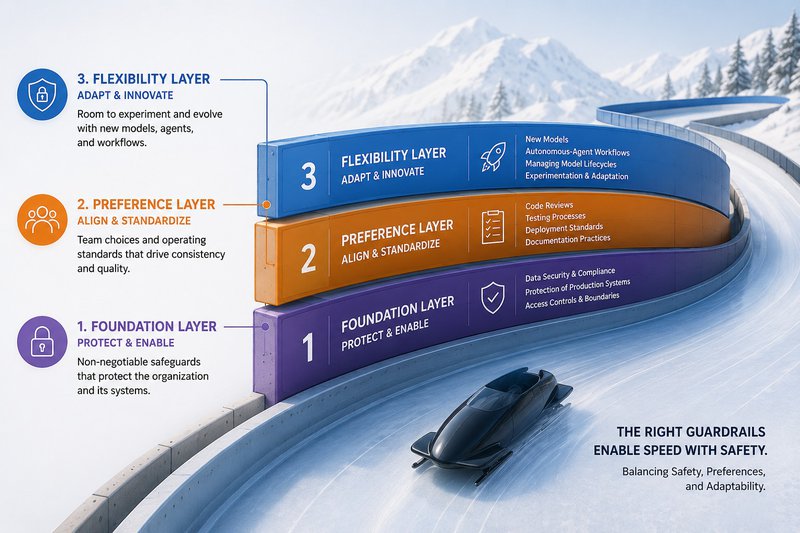
The foundation layer contains the non-negotiables. These are the controls that should remain relatively constant regardless of which AI tools are being used. Secrets should not be exposed. Sensitive customer data should remain protected. Production systems should have appropriate safeguards. Compliance and security requirements should be respected. These controls form the bedrock of secure AI development.
The second layer contains team preferences and operational standards. This is where organisations define how they want development to occur. Code review requirements, testing expectations, deployment workflows, documentation standards, and architectural conventions all belong here. These guardrails create consistency while still allowing teams to evolve their practices over time.
The third layer provides room for movement and experimentation. This is particularly important as organisations begin adopting autonomous-agent workflows, where AI systems can perform increasingly complex tasks with minimal human intervention. New models emerge almost weekly, making managing model lifecycles an increasingly important operational capability. Agents gain new capabilities. Development workflows continue to evolve. This layer is intentionally flexible, allowing organisations to experiment, learn, and adopt new approaches without redesigning their entire operating model.
Together, these layers create a high-level ecosystem that is stable where stability matters and adaptable where adaptability matters.
The Next Competitive Advantage
Access to powerful AI models is becoming increasingly widespread. Over time, the technology itself will become less of a differentiator.
What may separate successful organisations from the rest is their ability to create environments where humans and AI can collaborate safely, effectively, and confidently while building scalable systems for the future.
That is why system design for AI is transforming into essential steps rather than a optional capability.
The organisations that thrive in the years ahead will not necessarily be those moving the fastest. They will be the ones that understand which guardrails must remain fixed, which standards can evolve, and where flexibility should be encouraged.
Because before you race down the track at 100 km/h, it is worth taking the time to build the barriers that keep you on it.
Getting the balance of AI freedom and safety isn’t easy. For specialised assistance with using AI for systems design, get in touch with FONSEKA. We will take the time to learn about you, your business and your goals so you can unlock AI-powered efficiencies without compromising on safety. Get in touch today at https://fonseka.com.au/contact