




Technology is here to serve us, augment our lives and improve society. Right? That’s the theory, but the reality is a lot murkier. As the years have gone by, it feels like ethical design has taken a back seat as we charge forward into a world more connected than ever. So this Halloween, let’s take a look at how modern tech can actually be spooky, the hidden costs of ignoring the warnings, and what that actually means for us.
1. Your Silent Companion (tech that’s always listening)

An increasing number of people believe their phones are secretly listening to them, using conversations to target ads, promotions or content. The good news is there is little evidence to back that up.
That doesn’t mean your tech isn’t recording you though — because it is. It’s just more subtle: through browser fingerprinting, analysing content you engage with, and collecting more data about you than they need — all practices hiding in the fine print they know you didn’t read but for which you gave your consent anyway.
Your tech might not be secretly listening through your microphone, but it probably knows more about you than even you do.
But unfortunately, there is emerging tech that actually is listening to you: from niche products like the friend AI companion, to now-mainstream devices like covert camera-glasses or features like Live Rewind and Siri Recap features.
And while you might trust Apple today when they say recordings don’t leave your device, features like these will no doubt expand to other kinds of tech from companies who have more opaque motives. Their prevalence is certainly something we need to be careful about.
2. A Ghost in The System (everything is hackable)
There’s a golden rule about technology: if you can interact with it, it’s objectively impossible to be 100% secure. Fortunately though, we live in a world where critical systems can reach an insane level of security where hacking them becomes uneconomical.
The problem? Not everyone treats security the same way.
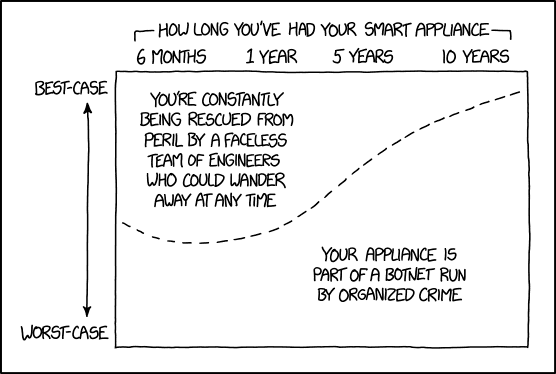
Whether it’s decades-old software left exposed, human compromise leading to an invisible back door or playing fast and loose with the term “secure”, there are potential security holes everywhere. Depending on the scale, the consequences might be insignificant. Or they could risk national security — just ask France what can happen when you connect supermarket fridges to the internet.
Some might assume their technology is secure just because it’s popular. Others may trust if technology is secure today, it’ll continue to be secure indefinitely. Both of those assumptions could lead to dire consequences.
Instead, we need to be more conscious about what we connect to the outside world, think about what could happen if something we own gets hacked, and ask whether thats worth being able to doomscrolling TikTok on your smart fridge.
3. The Devil on Your Shoulder (dark patterns)
As dark and deceptive patterns become more publicised, they become easier to spot. But that’s not always enough to avoid them, because your tech can weaponise them in spooky ways.
You might be familiar with some of the classic deceptive design strategies like pre-selection, pop-ups, confirm-shaming or nagging. But some go further by:
- building addiction loops that keep you engaged even when you want to stop
- including trick wording to make you agree to something you otherwise wouldn’t have
- making an action seem forced or mandatory, even when its not
These types of dark patterns are much harder to spot until it’s too late.
Unfortunately, the only fool-proof way to combat dark patterns is to eradicate them. And while some jurisdictions are making significant steps towards that future (like New York City’s new Click to Cancel rule), progress is slow and uneven.
For now, the best we can do is learn about them, and slow down when you’re feeling pushed or overwhelmed online.
But there’s good news, right?
Maybe. It depends who you ask. And depends who you trust.
The tech world moves insanely fast, and even faster now with AI. A company that might be all about privacy, security and ethics could tomorrow be bought out or otherwise taken over by those who are the opposite. The question is more than just how much you trust them today.
You may have been told to be careful about the digital world. The devices you own, platforms you use and information you share all contribute to the risk that something goes wrong. And once somebody else has your personal data, you’re no longer in control.
It seems that advice has been lost in recent years. So, in-case you missed it:
Happy Halloween, I guess? 🎃