




Software development processes become increasingly important as applications grow. In the early days of a project, introducing a new feature can be relatively straightforward. A small team understands the entire system, dependencies are limited, and changes can be made quickly.
Success, however, creates a new challenge.
Eventually, the biggest challenge is no longer building new functionality. It becomes introducing change without breaking the dozens, hundreds or even thousands of connections that already exist within the system.
Anyone who follows technology news will have seen this happen. Major outages affecting airlines, banks and global software providers are often caused not by cyber attacks or hardware failures, but by updates intended to improve the system.
Change is necessary for growth, yet it is also one of the greatest sources of risk.

The Reality of Developing at Scale
We recently experienced this challenge while working on a large insurance platform.
The client required a complete overhaul of the system’s calculation engine. The objective sounded simple enough: modernise the way premiums, commissions, fees and policy rules were calculated so the platform could support future growth.
As our team analysed the application, however, the scope became far more significant.
The calculation engine sat at the heart of the platform. Quotes depended on it. Customer portals relied on it. Reports, invoices, payment schedules, accounting exports and third-party integrations all consumed the same underlying calculations.
A change to a single formula had the potential to affect dozens of business processes.
At that point, the challenge was no longer writing new code. The challenge was ensuring that everything already working continued to work exactly as expected.
Why Software Systems Break
Most software failures are not caused by poor developers making bad decisions. More often, secure software systems break because complexity accumulates over time.
As software evolves, teams introduce:
- New features
- Third-party integrations
- Additional developers
- New customer requirements
- Expanded business rules
Each addition creates new relationships within the system. Many of these relationships remain invisible until a change exposes them.
This is particularly common in long-running business applications. A developer may update one section of the codebase without realising another workflow depends upon the same logic. The change itself may be correct, but the unintended side effects create problems elsewhere.
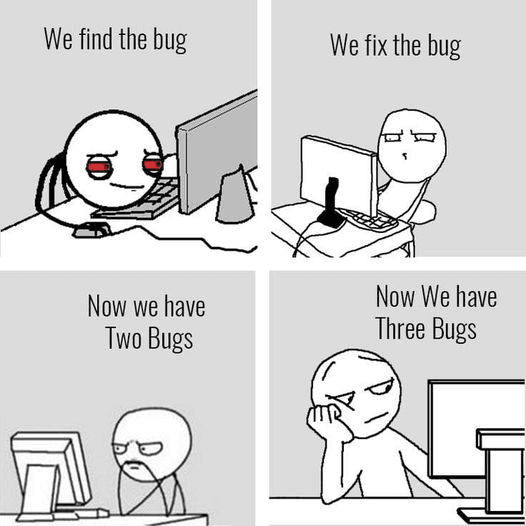
The larger the platform becomes, the greater this risk grows.
Four Software Development Processes That Reduce Risk
Mature software development processes help teams manage complexity while continuing to deliver new functionality. Rather than relying on luck, successful teams build safeguards into the development lifecycle.
1. Automated Testing
Automated testing provides a safety net for critical business functionality.
Tools such as PEST allow Laravel developers to verify calculations, workflows and business rules before code reaches production. When a developer introduces a new feature, automated feature or unit tests help identify regressions before customers experience them.
2. Feature Flags and Incremental Releases
One of the safest ways to introduce change is to reduce the size of each release.
Rather than deploying large batches of functionality at once, mature teams often use feature flags and incremental releases to gradually introduce new capabilities. This allows new features to be tested in production with a limited audience before wider rollout.
If issues emerge, the feature can often be disabled immediately without requiring a full deployment rollback. As systems become larger and more complex, this approach significantly reduces the risk associated with change.
3. Repository and Workflow Security
As systems grow, the code itself is only one part of the equation. The development process surrounding that code becomes just as important.
A surprising number of production incidents can be traced back to weaknesses in source control, deployment workflows or repository security rather than flaws in the application itself. An unauthorised change, an exposed secret, or a poorly configured workflow can introduce risk long before code reaches production.
This is where tools such as Laravel Moat can help by reviewing the security posture of GitHub repositories and organisations. While no tool can eliminate risk entirely, improving repository security helps create a more reliable development environment. Combined with strong software development processes, it reduces the likelihood of avoidable mistakes making their way into production.
4. Code Reviews

A second set of eyes, whether they are human or AI, can often identify risks that the original developer cannot see.
Code reviews improve software quality, encourage knowledge sharing and help teams maintain consistent standards across the codebase.
5. Staged Deployments and Monitoring
Production should never be the first place software is tested.
Staging environments, deployment procedures and monitoring tools allow teams to validate changes before they affect customers. They also provide early warning signs if something behaves unexpectedly after release.
Finding the Balance Between Speed and Stability
Many organisations struggle to find the right balance.
Move too quickly and the risk of outages increases. Introduce too many controls and development slows to a crawl. The most effective software development processes sit somewhere in the middle.
They create enough structure to reduce risk without preventing innovation. They provide confidence without creating unnecessary bureaucracy. Most importantly, they allow development teams to continue delivering value while maintaining trust in the platform.
We have spent decades debating over all the “agile methods”. Human Talent and plan-driven processes in place allow for the balance to be found with improved predictability for changes
Final Thoughts
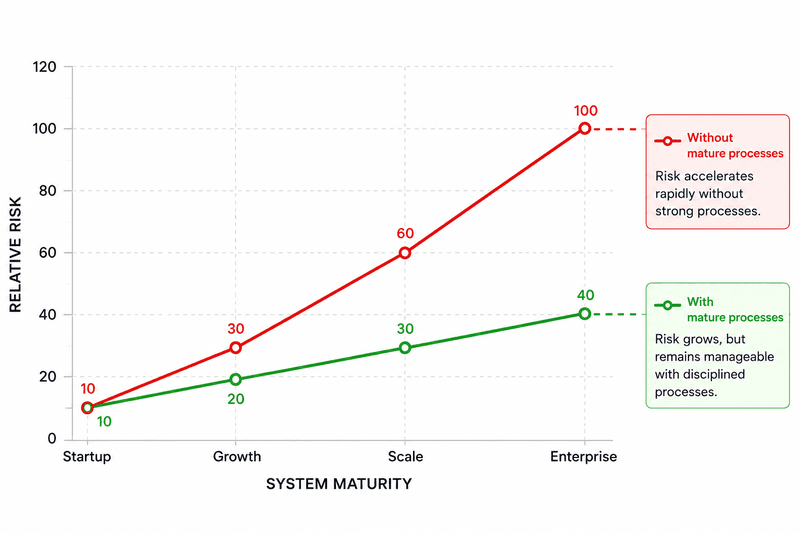
The organisations that scale successfully are not those that avoid mistakes entirely.
They are the organisations that recognise complexity as an inevitable consequence of growth and invest in the software development processes needed to manage it.
Automated testing, architectural boundaries, code reviews and disciplined deployment practices may not be the most exciting aspects of software development. Yet they are often the difference between a platform that scales successfully and one that becomes increasingly fragile over time.
Because at scale, success is no longer measured solely by how quickly you can build something new. It is measured by how reliably you can introduce change without breaking the thousands of invisible connections that already exist.