



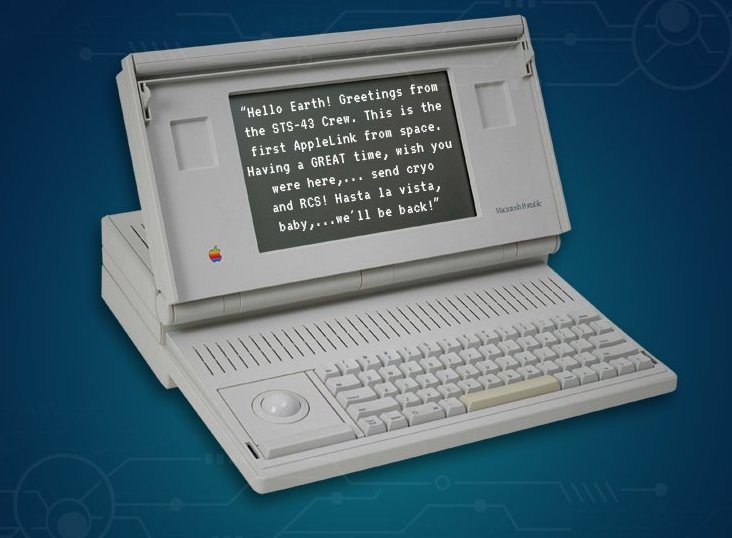
33 Years Ago on 9 August, the first email was sent to Earth using a Mac Portable aboard the Space Shuttle Atlantis. Two astronauts on the spacecraft, James Adamson and Shannon Lucid, wrote,
“Hello Earth! Greetings from the STS-43 Crew. This is the first AppleLink from space. Having a GREAT time, wish you were here,...send cryo and RCS! Hasta la vista, baby,...we'll be back!”
This was a remarkable history to today’s Astronauts enjoying 600 Mbps Wi-Fi in the space habitat, connecting to the internet via ground-based antennas called the Near Space Network and a system of Tracking and Data Relay Satellites.
One of the most groundbreaking developments in this area has been the advent of space email. This innovation has not only revolutionised how astronauts communicate but has also led to significant advancements in terrestrial communications -- AKA Wi-Fi 5G, Internet Data... -- what we are enjoying today!
The Birth of Space Email
The concept of space email emerged from the need for astronauts to have a reliable way to send and receive messages. Yet, traditional radio communications were often plagued by delays, interference, and limited bandwidth. Which makes it not suitable to be directly used for space communication. To address these issues, NASA began exploring digital communication technologies that could provide more seamless connectivity.
Overcoming Challenges
It wasn’t easy, developing an effective space email system had several unique challenges:
- Latency: The vast distances between Earth and spacecraft result in significant signal delays. Engineers had to design protocols that account for these delays without compromising message integrity.
- Bandwidth Constraints: Limited bandwidth in space meant that data transmission had to be optimised for efficiency.
- Reliability: Space environments are harsh, with high levels of radiation and extreme temperatures. Communication systems needed to be robust enough to withstand these conditions.
Technological Innovations
So how did they overcome the challenge? NASA and several space agencies have come together with a solution to handle the harsh environment in space.
- Delay/Disruption Tolerant Networking (DTN): It is a protocol that enables data delivery in situations that involve disconnection, delays, and unmatched data rates. The DTN protocol was designed to handle intermittent connectivity by storing data packets until a stable connection could be established.

- Advanced Compression Algorithms: For instance, Adaptive Coding and Modulation (ACM). Which converts link margin to an increase in the data throughput of satellite links. In other words, reducing the size of transmitted data without losing essential information.

- Error Correction Techniques: Enhanced error correction methods like Reed-Solomon Codes, and Low-density parity-check code. It ensured that messages remained intact despite potential disruptions during transmission. Although Space is silent, it’s noisy in terms of radio transmission.
And more technologies are invented to realise space communication... It didn’t just come in one day. The realisation of real-time communication from space to Earth has gathered many intelligences and innovations in the “space.”
So, how did this breakthrough improve our lives?
The advancements are not just “fancy technologies” for astronauts. This being the first email sent from space, has changed a lot in terrestrial communications:
Improved Internet Connectivity: DTN and technologies so as like, have been adapted for use in remote areas on Earth where traditional internet infrastructure is lacking or unreliable. According to the United Nations 17 SGD, 95% of the world has coverage of the internet at least 3G. DTN has brought connectivity to regions previously considered unreachable. It is the hero that enables you to stay connected to Google Maps in the middle of nowhere during your WA round trip.

Enhanced Data Transmission Efficiency (We can’t miss this one): Compression algorithms initially developed for space applications are now used widely across various industries. And that’s not all, it also plays an important role in improving data transmission efficiency in bad weather events, allowing you to stay connected to your loved ones during the time of the 2022 eastern Australia flood disaster.
Greater Reliability in Harsh Environments: Last but not least, error correction techniques have also improved the communication systems designed to withstand other harsh environments on Earth, such as deep-sea exploration and disaster recovery operations.
This email sent from space not only marks a tech milestone but also opens up a new journey to a more accessible and inclusive world.
33 Years later today, are we grateful for what we have?
The journey from developing a reliable communication system for astronauts has led to remarkable advancements that benefit us all here on Earth. As we continue pushing boundaries beyond our planet's atmosphere, innovations born out of necessity will undoubtedly keep transforming how we connect with each other—both near and far away—from the home base down below!
The world is advancing fast. Stay ahead of the curve with our cutting-edge solutions. We are here to help you update your product to the latest trends with ease. We work together to optimise your product so it's ready for the future. Get in touch today with FONSEKA!