


What is Dart?
Dart was developed by Google in 2011, and was designed to be Google’s “JavaScript Killer”. It was meant to be a replacement for JavaScript in browsers. This did not work out as intended. By the time it was ready to be released, JavaScript was way ahead, and catching up would not have been possible. So, Google gave up on the idea of replacing JavaScript, and instead changed Dart into a programming language used to develop client-optimised applications for any platform.

Initially, Dart was used internally at Google for their products. It started to gain more attention in 2017 when Google officially announced the beta version for Flutter for cross-platform mobile app development. Developers became eager to adopt Flutter for its potential. Since then, due to it being the language needed for Flutter, it has become drastically more popular.
Dart & Flutter

Flutter is Google’s open-source user interface (UI) software development kit (SDK). It can compile Dart code into native code to develop beautiful apps for mobile; Android and iOS, desktop; Linux, Windows and MAC, and the web. On that note, with just a single code base and this framework, two different apps (for Android and iOS) can be made at the same time.
Flutter also provides a wide range of pre-built and pre-designed UI elements in the form of widgets which developers can use to create good user interfaces.
You can read more about Google’s Flutter here.
How is it Structured?
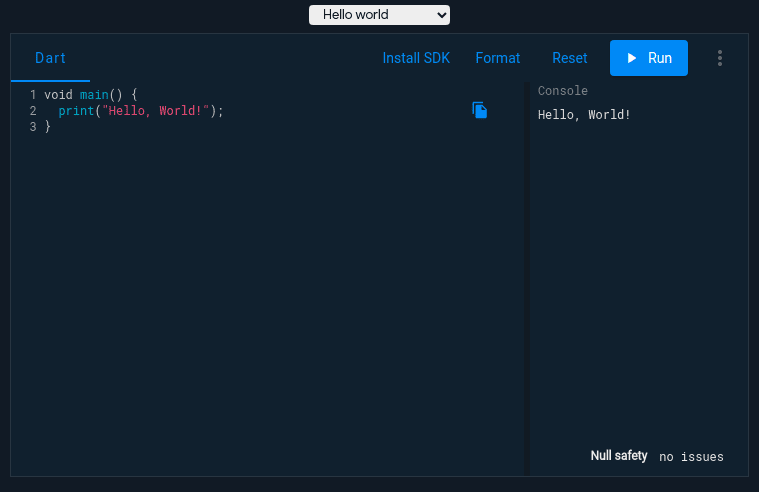
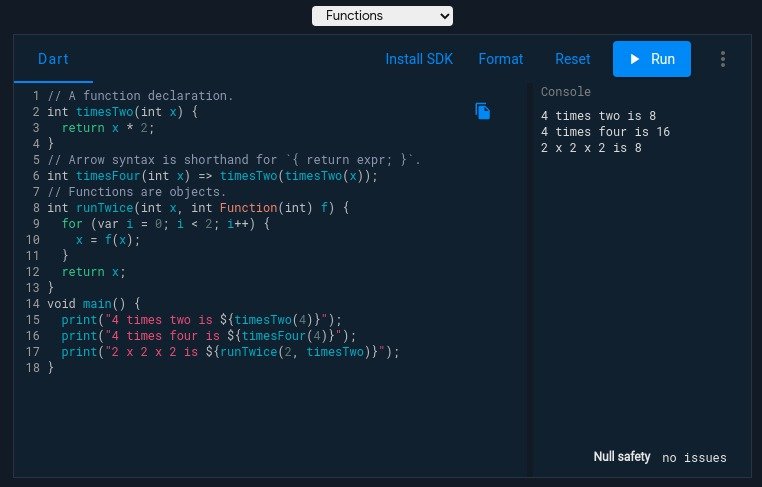
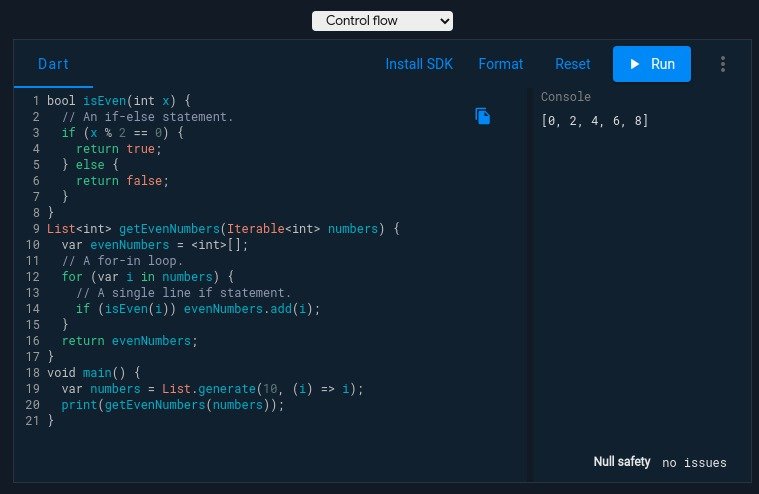
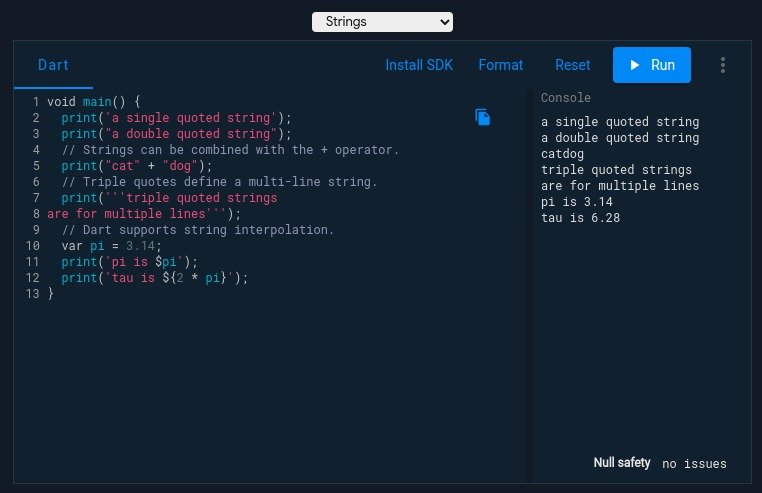
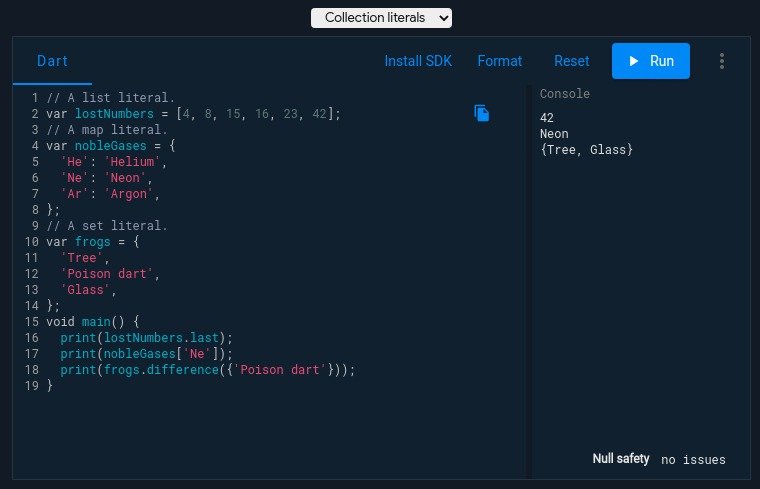
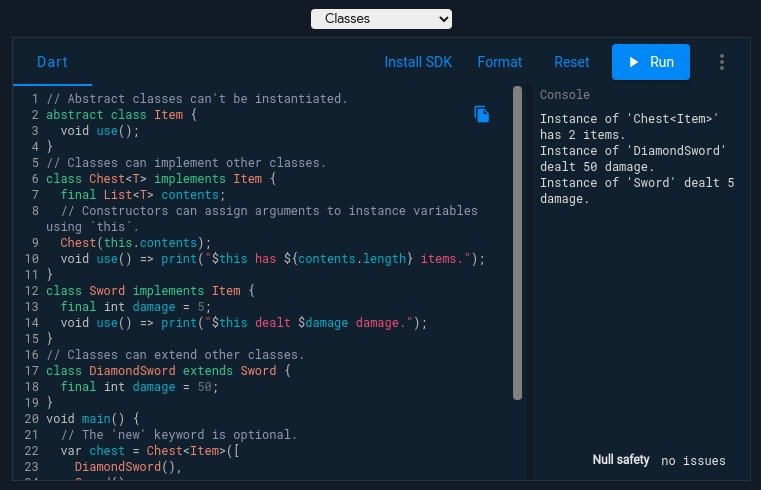
Dart is an object-oriented programming (OOP) language similar to C# and Java, but it looks more like JavaScript and C.
Like many imperative computer programming languages (C# and Java):
- The entry point of a program is the
main()method. It acts as a starting point for Flutter apps too. - For most data types,
nullis the default value. - If conditions, loops, switch-case, break and continue statements have the same flow control.
- Classes only support single inheritance. A class can have many implementations of interfaces, but it can only have one superclass.
- Abstraction works in a similar way, where it allows for abstract classes and interfaces.
Unlike imperative computer programming languages (more like JavaScript):
- It has type inference. The data type of a variable does not need to be declared. Dart will figure out what the variable is being used for. So instead of a
String message, it is avar message. - All data types are objects. That is why the default value is
null. So for numbers, rather than0as the default value, it isnull. - A default value of the parameters passed into a method can be declared. So if no value is given when the method is called, it uses that default value.
- The return type of a method does not need to be declared in the method signature.
- When creating a new object, the keyword
newis optional.
There are several more similarities and differences, have a look at Dart’s documentation if you want to know more.
What are the Pros and Cons of Dart?
Pros
Flutter
Dart is the language required for Flutter, this in itself is a major advantage. Flutter has many features to help develops beautiful apps quickly that can be natively compiled for both Android and iOS.
Uses both JIT and AOT Compilation
Dart has the unique ability to handle both Just in Time (JIT) and Ahead of Time (AOT) compiling. In JIT, it is able to compile for very fast development cycles, which is critical for iterative development. It can be used to improve application runtime and performance speed. In AOT, Dart can be directly transformed into native machine code. For mobile applications, the code will be compiled for multiple processors and for multiple platforms.
Cross-Platform
With the ability to compile native code, a developer can create both Android and iOS applications using Flutter. It will take into account the difference between the two platforms and make the necessary changes. So there will be fewer problems when adapting an app to each of the OS. By being able to create two separate apps at the same time, it will save time and money.
Cons
Lack of resources
Dart is a fairly new language for most developers outside of Google. Although Google has put a lot of work into Dart’s Documentation, there is still a lack of resources and solutions for specific problems. Furthermore, the Dart and Flutter community are pretty small.
Learning Curve
Learning Dart can be difficult for beginners as Dart is not a commonly used language. With the lack of resources, the level of difficulty increases. With Dart being an (OOP) language, but having JavaScript-like syntax, it can get confusing even for experienced developers, and not just beginners. Along with learning Dart, one would have to learn how to use Flutter also, the two go hand-in-hand.
Your App
If you have a great idea for an app but do not have the know-how to get it up and running. We at Fonseka Innovations can do it for you. We will help you build and maintain your app.
Contact us now to innovate with us! We are here to support you!