



Starting development on a brand new project is always exciting: you get to break away from previous design choices and “build the right way” from the start. But there are risks and dangers with new projects. Starting fresh and building up to a full release is daunting, time consuming and requires a lot of upfront investment before any return on your investment. So let’s see why first building an MVP might be the answer.
What is an MVP?
An MVP — a minimum viable product — represents a functional product that has just reached a state generally usable by customers. Instead of a prototype or proof-of-concept (POC), it contains basic functionality but is generally developed with less emphasis on long-term development strategy and more on short-term goals. Developing an MVP means refining your scope to minimum — no scope creep; no feature requests; your goal is to build the essential features.
The goal of an MVP isn’t to do everything or to get everything right; it’s to fulfil your scope well so customers can start using your product.
Importantly, it doesn’t mean vibe coding your way without a plan. The scoping and discovery phase is still incredibly important, but many decisions can be resolved as “are we leaving room to expand this system later”.
Nor does it mean practicing loose development standards or scarifying quality. Despite the ‘minimum’ and ‘viable’ parts of the phrase, an MVP needs to be polished, presentable and usable. After all, it’s your first release — it needs to be good.
The Benefits of Building an MVP
1. Lessen the Business Risks

Building a product from scratch comes with significant business risks:
- If you overestimate the number of people who will use your software, you’ll end up with a far lower return on your investment than otherwise predicted.
- The longer you spend in a pre-release phase, the longer you are without a platform generating revenue. While you get there, funding has to come from somewhere else, which isn’t always sustainable.
Building an MVP can provide a stop-gap to limit risk. If you release your product and nobody wants it, it’s better to find out as early as possible. On the other hand, if everybody loves it, you’ll feel more confident committing the extra resources to make it shine. MVPs are one of the best cost-effective ways to find out which a product is.
2. Iterate, Evaluate and Make Big Changes
An MVP is still in it’s early stages, which means gathering feedback from stakeholders, potential customers or early adopters can result in much more effective outcomes. The crux of a good MVP is the ability to test market concepts, take on feedback, and iterate quickly. And if you realise your scope complete hits the mark, you know to go back to the drawing board before too much time invested.
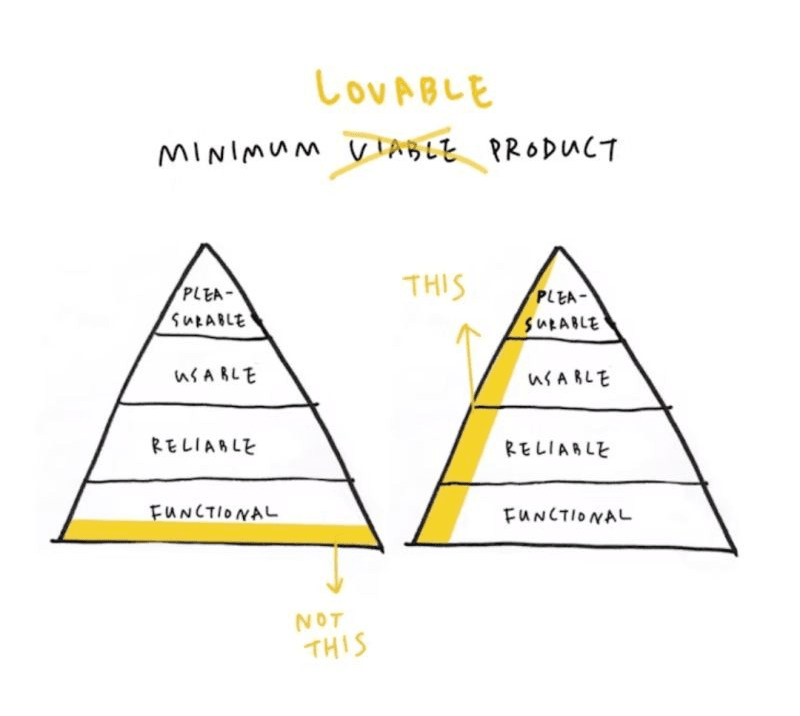
Getting early evaluations from potential customers and users can be invaluable for direction. A working demo can both provide the confidence in your product while facilitating tangible feedback. Importantly, it gives you a second chance to get things right if what you’ve built misses the mark.
It’s at this stage, your development system should be to build-measure-learn — if all you’re doing is building, you’re putting a lot of trust in untested foundations. The ability to follow that cycle is unique to early-stage projects, so take advantage of it before you reach full-scale product development.
3. Reach Market Faster with a Smaller Bang

It’s logical that an MVP will take significantly less time to reach market than a full ‘v1.0’ release. And even though you’ll be missing features you would like to have implemented, you can start to reap some of the rewards from your hard-work. Plus, getting your product out there can help to build momentum and users, which can both feed back into the iteration process.
It also reduces the impact of a ‘big bang’ release — where a release has so many new things that could go wrong. An MVP naturally reduces this risk but having a smaller bang, and future releases benefit as they can also be smaller. This helps you keep on-top of issues as they arise and respond quicker if things go wrong.
Conclusion
Successful software products rarely perfect from the start. Take Gmail for example, which was in beta for over 5 years while they tested, iterated and improved the service. Instead of a large upfront investment and development period culminating in a single release, starting small with incremental releases can have genuine benefits.
At FONSEKA we’ve seen the importance of an MVP — not just in getting products into the real world but as a way to sustainably build products. They’ve been a invaluable tool for us to prove concepts and show how platforms can have real effects.
If you’re looking to build something new but concerned about the investment, chat to FONSEKA today about why an MVP might be for you. Whether you’re still at a concept phase or ready to start developing, we can bring your idea to reality.