


Social enterprises are an innovative breed of businesses that exist to create a fairer and more sustainable world.
By combining profit-making activities with social objectives, these businesses address some of the most urgent global challenges, including poverty, education, and sustainability. In 2024, we’re witnessing new trends in social enterprise products that not only meet market demands but also promote positive social causes.
This shift highlights a growing movement towards more effective, efficient, and impactful solutions, where businesses innovate while solving critical societal issues. As a result, social enterprises are increasingly capable of addressing both societal and environmental needs, making a lasting positive impact on communities.
Distribution of Social Enterprises Across Australia
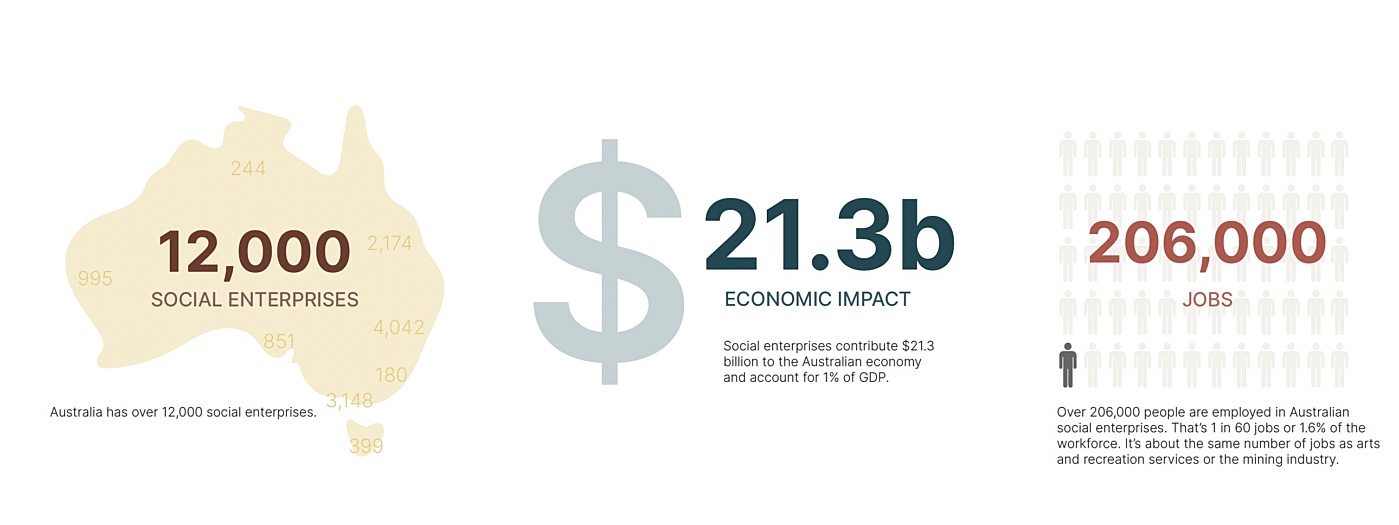
Currently, there are 12,333 social enterprises across Australia, spread throughout the country. The breakdown is as follows:
- 4,042 in New South Wales
- 3,148 in Victoria
- 2,174 in Queensland
- 995 in Western Australia
- 851 in South Australia
- 399 in Tasmania
- 244 in the Northern Territory
- 180 in the Australian Capital Territory
Size Breakdown of Social Enterprises
These enterprises are categorised by size as follows:
- 24% are micro enterprises (1–4 staff)
- 37% are small enterprises (5–19 staff)
- 31% are medium-sized enterprises (20–199 staff)
- 8% are large enterprises (200+ staff)
Contribution to Society
Social enterprises continue to help improve the lives of marginalised and disadvantaged groups. They provide services like budget-friendly housing, job skills training, and environmentally friendly products. Moreover, these businesses operate across various sectors, including facilities management, catering, hospitality, business administration, and design.
Additionally, social enterprises (including at least 518 registered by Social Traders) allocate an average of 31% of their revenue to creating positive social impact. Their contributions are directed as follows:
- 58% supporting employment and training opportunities
- 35% addressing specific community needs
- 13% redistributing profits to charities or not-for-profits
Key Beneficiaries
Social enterprises primarily benefit the following groups:
- People with disabilities
- Charitable organisations and non-profits
- Migrants and refugees
- Aboriginal and Torres Strait Islander communities
- Youth

Key Achievements
Since 2022, Australia’s social enterprise sector has seen substantial growth, fuelled by creative ideas and a strong focus on ethical buying. As a result, this growth has led to significant advancements, which have created greater opportunities for social enterprises to expand and achieve a lasting positive impact.
Additionally, this growth has significantly impacted job creation, revenue generation, and reinvestment in social programs. Here are the key points of this expansion:
- Social enterprises have created 31,000 jobs, providing opportunities to individuals who are often excluded from the workforce.
- Notably, 45% of employees come from groups typically shut out of work.
- The sector has generated $2.25 billion in total revenue, with $1.74 billion (77%) coming from trade activities.
- Additionally, social enterprises have reinvested 31% of their revenue ($690 million) to create a positive social impact, demonstrating their commitment to lasting change and social responsibility.
Social Enterprises: What's Next?
As 2024 progresses, we can expect to see even more groundbreaking products from social enterprises, combining business success with social impact. Moreover, these products will focus increasingly on sustainability, inclusivity, and providing tangible solutions to some of the world’s most pressing challenges. Here are some standout examples of how social enterprises are combining purpose with profit to create impactful solutions:
Accessible Mental Health Services
Mental health remains a critical issue in 2024, with growing demand for affordable and inclusive services. Social enterprises are addressing this by offering fee-for-service models that reinvest revenue into expanding mental health access and workforce development. For instance, Solasta by Sonder operates as a fee-for-service practice, reinvesting its surplus into free mental health services and training programs for future practitioners in South Australia.This approach demonstrates how financial sustainability and social impact can work hand-in-hand, making mental health care more accessible and inclusive.
Social Supermarket
Social supermarkets are emerging as a key trend in addressing global food poverty. These innovative enterprises combine the affordability of heavily discounted groceries with a mission to empower underserved communities. As the cost of living rises and food insecurity becomes a pressing issue, social supermarkets are stepping in to provide both immediate relief and long-term solutions. For instance, the UK-based Community Shop has set the benchmark for combining discounted food with comprehensive social support.
Eco-Friendly Construction Materials
Eco-friendly construction materials are gaining traction as a key trend in sustainable development. Companies like Green Antz Builders are revolutionising the construction industry by turning plastic waste into durable, affordable building materials.
As the world faces growing concerns about plastic pollution and the need for low-cost housing, eco-friendly construction solutions are providing a dual benefit: reducing waste while meeting the demand for sustainable housing.
Green Antz has pioneered the production of eco-bricks and eco-pavers made from recycled plastic waste, helping to reduce environmental harm while providing affordable, high-quality construction materials to underserved communities.
Water Purification Devices Powered by Solar Energy
Water scarcity is one of the most pressing global challenges of the 21st century, affecting millions of people around the world. With the growing impacts of climate change, overpopulation, and pollution, access to clean, safe drinking water has become increasingly limited, particularly in remote and disaster-stricken regions. Solar-powered water purification solutions are emerging as a key trend in tackling water scarcity and contamination, particularly in remote or disaster-affected areas. Desolenator is leading the charge by offering an off-grid, solar-powered system that transforms any water source—including seawater, brackish water, and water contaminated with heavy metals—into clean, potable water. Its innovative technology that eliminates the need for consumables like filters or membranes, making it a cost-effective, scalable solution for underserved communities.
Sources:
- Business for Good: The size and economic contribution of social enterprise in Australia (Social Enterprises Australia, 2022);
- Pace 2023: Profile of Australia's certified social enterprises (Social Traders, 2023)
- Why not-for-profits should care about the rise of social enterprises (Community Directors,2023)
- 14 Social Enterprises Making Clean Water and Sanitation Accessible for All (MovingWorlds,2021)
- 22 Awesome Social Enterprise Ideas and Examples (Danielle Sutton, 2022)